


Академиялық негіздеме
Академиялық негіз Кез келген Helen Doron сыныбына кірсеңіз, балалардың көңілді білім алып, ойнап және өздеріне жаңалық ашып жатқанын көресіз. Балалар көңілді, жас ерекшелігіне сай іс-шаралар және мұғалімдерден алынған позитивті пікірлер арқылы жеңіл үйренеді.
35 жылдық білім беру тәжірибеміз бен дәлелденген жетістіктерімізге негізделген әдістемеміз үздіксіз оқуға деген сүйіспеншілікті қалыптастыратын, позитивті қолдау мен қолайлы ортаға негізделген оқу бағдарламасын қамтиды.
Helen Doron оқушылары оқуды жақсы көреді және қалай оқу керектігін үйренеді. Біз тіл, сауаттылық, тіпті математиканы түпнұсқадағы қызықты әндер арқылы үйретеміз. Музыка мен би арқылы балалардың ойлауын дамытып, олардың қабілеттерін ашуға мүмкіндік береміз. Біздің бағдарламалар ғылыми деректерге негізделе отырып жасалынған. Музыканың мидың дамуына оң ықпалын тигізіп, жаңа нейрондық байланыстар қалыптастырып, математика мен тіл сияқты басқа да салалардағы қабілеттерді дамытатындығын ескере отырып құрастырылған.
Helen Doron білім беру тобы халықаралық деңгейде танылып, “Global Franchise Magazine”-де жариялаған “Ең үздік балаларға арналған білім беру франшизасы”, Германияда “Ең үздік тіл мектебі”, Испанияда “Жылдың тіл мектебі”, Қытайда “Ата-ана сенім марапаты” және басқа да көптеген марапаттарға ие болды.

Efficacy Assessment of Pre-School EFL Learners in Three Hungarian Towns
By Dr Judit Kovács
As a result of the empirical research at Helen Doron learning centres in three Hungarian towns, it has been proven that an early encounter with learning an additional language results in early multi-competence if the lessons are delivered in an activity-based, enjoyable way. Additionally, age-relevant language development contributes to a higher level of flexibility in children’s thinking and overall intellectual growth. The study shows that for success to happen, very young learners need specially trained teachers who follow a particular curriculum, and Helen Doron programmes provide all necessary conditions for successful early language development.
German Academic Research Shows 97% Satisfaction Rate by Parents of Helen Doron Early English Students
By Professor Heiner Böttger
The Department of English Teaching at the Catholic University of Eichstätt-Ingolstadt, Germany carried out quantitative research based on questionnaires, as well as qualitative fieldwork in selected Helen Doron Learning Centres. The findings from the questions regarding the effects of attending a course on the institutional English lessons and the performance of the respondents were extremely impressive. Both children and parents cite the Helen Doron courses as leading to increased self-confidence, higher linguistic ability and a secure status in English lessons at school.
An Examination of the Helen Doron Early English Methodology
By Masaryk University Faculty of Education, Czech Republic
This study looks closely at the Helen Doron methodology for teaching English to very young learners. It provides an in-depth introduction to the principles of the methodology and shows how it links to child development and to the nature of child learners. The official lesson plans provided by the Helen Doron Early English methodology are analysed as well. Based on expert opinions in the respective areas, the Helen Doron Early English methodology, on the whole, was found valid and appropriate to child learners.
Teaching English to Very Young Learners
Dora Rolj Kovačević, Prof. Dr. sc. Višnja Pavičić Takač
This study concluded that children need hands-on activities to engage in their own learning.
Teachers provide a range of activities to get young learners’ attention and arouse constant interest. Physical activities contribute positively to learning when coordinated with language. It is also possible to make use of fine-motor activities in classroom activities. Studies show that early language acquisition is necessary to reach native-like proficiency, especially in pronunciation. While there is a consensus on the presence of critical period, it is pointed out that there is no single age but the ability to acquire a language decreases over time.
Finally, researchers also find out that cognitive development affects the language acquisition process as well as language development. Therefore, older learners who are cognitively mature have faster start but it is only short term advantage over young learners. As a final note, further research is necessary on young learners’ learning process and their learning styles. There is also a limited number of studies on future effects of early start in acquiring the foreign language rather than the second language. Future research should focus on age factor in proficiency of each skill and teaching very young learners a foreign language in accord with appropriate activities.
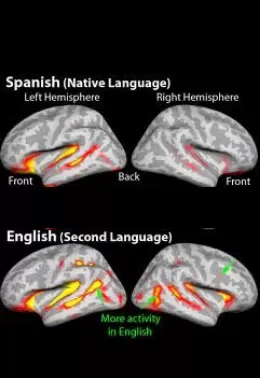
Neuroscience and the Bilingual Brain
By Dr Judy Willis
More languages lead to more efficient processing. Compared to monolinguals, bilingual children develop greater attention focus, distraction resistance, decision-making judgment and responsiveness to feedback. The correlated fMRI scans of these children reveal more activity in the prefrontal cortex networks that control these executive functions.